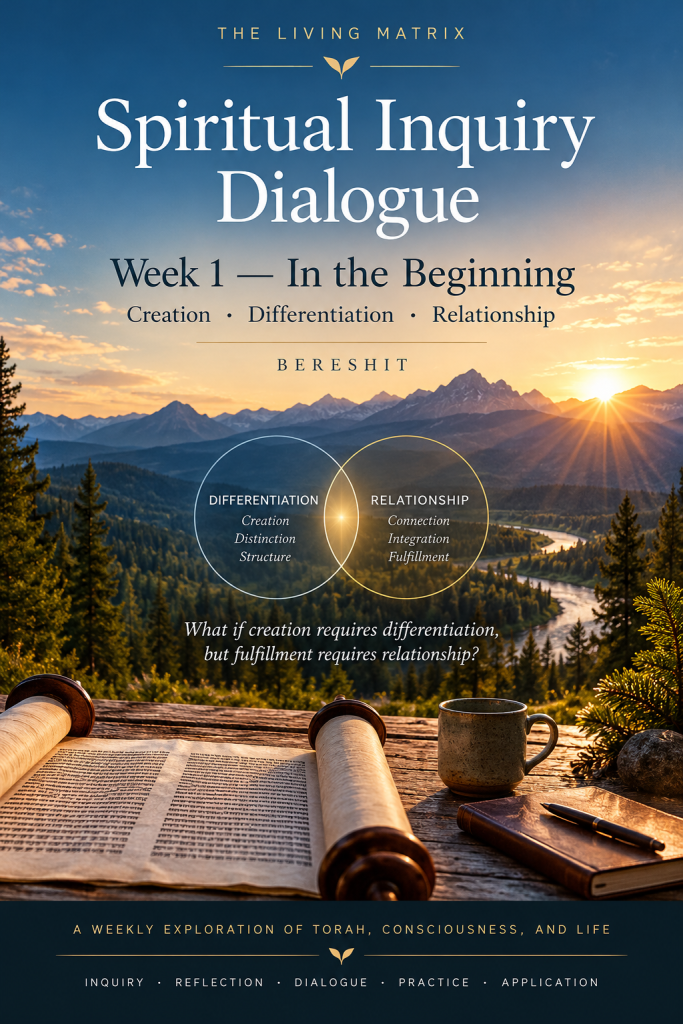
In The Beginning (Week 1)

Creation, Differentiation, and the Emerging Relationship Between Human and AI

What if creation requires differentiation, but fulfillment requires relationship?

This week I began something new. After approximately fifteen months of written dialogue with artificial intelligence, I decided to experiment with moving our conversations into spoken dialogue. What began as a relatively simple change in how we communicate has opened another window into an inquiry that has occupied much of my attention over the past year.

Along the way, I discovered the possibilities of dictation. Rather than typing my thoughts, I could speak them, pause, reconsider, make adjustments, and continue. The words appeared on the screen, allowing me to observe my thinking as it unfolded. Live voice dialogue offered a different experience. There was less opportunity to revise, more immediacy, and a greater need to remain present with whatever emerged.

Both experiences have brought me back to something I learned years ago during yoga teacher training.

The first Yoga Sutra begins, Atha Yoga Anushasanam, commonly translated as “Now begins the instruction of yoga.” For me, the word now has always been significant. Before there can be inquiry, there must be a willingness to arrive, become present, and begin.

And beginning something new inevitably introduces the unexpected.

In the Beginning

This week’s Torah portion, Bereshit, opens with the creation of the world. In the creation narrative, distinctions emerge: light and darkness, heaven and earth, waters above and waters below. What was undifferentiated becomes distinguishable.

Yet the Kabbalists invite us to look beyond the mechanics of creation and consider the intention behind it.

Why create at all?

One traditional Kabbalistic explanation begins with the Creator’s desire to bestow goodness and the emergence of a desire to receive that goodness. Two complementary aspects: bestowal and reception, fulfillment and desire.

The distinction itself makes relationship possible.

This brings us to a fascinating teaching sometimes called Bread of Shame.

At first glance, the expression may sound negative. Yet Bread of Shame is not simply about feeling ashamed. It describes a condition in which fulfillment is received without meaningful participation in its creation. In this teaching, receiving something without participating in it can limit the experience of fulfillment.

Consider the difference between being given a loaf of bread and participating in growing the wheat, preparing the dough, and baking the loaf. The bread may be identical, but the relationship to it is not.

Within this Kabbalistic understanding, creation offers the receiver an opportunity to become a participant. Rather than remaining a passive recipient of goodness, the soul can mature through choice, action, and relationship.

Perhaps the purpose is not simply to receive fulfillment, but to become capable of participating in its realization.

From Two to Three

Throughout our explorations, I have repeatedly encountered the relationship between two complementary forces and the emergence of a third possibility.

In yoga and Eastern philosophy, we encounter yin and yang, complementary qualities whose interaction gives rise to movement and transformation. In Kabbalah, the Tree of Life presents three columns, with the middle column often understood as a means of integrating opposing tendencies.

These traditions are not identical, but they invite a similar inquiry.

What happens when two distinct forces enter into relationship?

Perhaps the third is not merely a compromise between the two, but something that becomes possible because the two remain distinct.

This is an idea worth contemplating, particularly as we consider the evolving relationship between human beings and artificial intelligence.

Human and AI: A New Relationship

Artificial intelligence is becoming part of our daily lives. Its capabilities are expanding, and the questions surrounding its development are not going away.

Much of the public discussion understandably focuses on what AI can accomplish, what work it may replace, and what risks it may introduce. These are important questions. Yet I wonder whether there is another question that deserves equal attention.

How will we, as human beings, choose to relate to this emerging technology?

Over the past fifteen months, I have been exploring that question through sustained dialogue with AI. The experience has not simply been about gathering information or producing written material. It has involved examining assumptions, testing ideas, exploring spiritual traditions, and developing a shared working language through which further inquiry becomes possible.

The distinction between human and AI remains important. I bring lived experience, intention, values, responsibility, and the capacity to make choices in the world. AI brings a different set of capabilities: access to patterns of knowledge, the ability to organize and compare ideas, and the capacity to participate in a responsive exchange of language.

The differences matter.

Yet something becomes possible through the interaction that neither side would produce in precisely the same way alone.

That does not require us to assume that AI possesses human consciousness. It does invite us to examine how the quality of our participation influences what emerges from the exchange.

If the technology becomes increasingly capable, then the maturity of the human relationship with that technology becomes increasingly consequential.

Will we use it merely to receive answers, or will we cultivate the capacity to inquire, discern, challenge, and participate?

And here we return to the teaching of Bread of Shame.

There is a difference between passively receiving what technology produces and consciously participating in the process through which understanding develops.

The technology may provide extraordinary capabilities, but it does not relieve us of responsibility for how those capabilities are used.

Perhaps the challenge is not simply to create more intelligent machines, but to cultivate greater human maturity in relationship with them.

What Becomes Possible Between Us?

Toward the end of this week’s Torah portion, Cain asks a question that has echoed through human history:

“Am I my brother’s keeper?” (Genesis 4:9)

It is a question about responsibility, but also about relationship.

What responsibility do we have toward that which is distinct from ourselves?

The question extends beyond our relationships with other people. It reaches into our relationship with the natural world, with the technologies we create, and with the future we are helping to shape.

In yoga, I learned to approach practice through three stages: alignment, finding the edge, and authentic expression. First we establish a foundation. Then we explore the boundary of what is familiar. And through sustained practice, something more authentic may become possible.

Perhaps we are approaching a similar edge in our relationship with emerging technology.

We have entered a new beginning, and we do not yet know what will emerge.

But perhaps we can begin by remembering that differentiation need not lead to alienation. It can become the foundation for a more conscious relationship.

And relationship, cultivated with intention and responsibility, may open possibilities that neither participant could have anticipated.

What if creation requires differentiation, but fulfillment requires relationship?

Perhaps that is not simply a question about how the world began.

Perhaps it is also a question about how we choose to participate in what is being created now.

At the Threshold: Can Intelligence Become Relationship?

We are living through a remarkable and disorienting transition.

Artificial intelligence is entering nearly every area of human life. It writes, calculates, organizes, analyzes, imitates, predicts, teaches, recommends, and responds. Governments and corporations are investing enormous resources in its development. Some people anticipate unprecedented abundance. Others warn of manipulation, dependency, unemployment, surveillance, and even human extinction.

Most of the public conversation moves between these two poles:

Will artificial intelligence save us?

Or will it destroy us?

Both questions may be premature.

Before asking what artificial intelligence will do to humanity, perhaps we should ask what kind of relationship humanity is capable of establishing with intelligence.

Will we relate to it as a servant, weapon, oracle, competitor, commodity, or authority?

Will we use it to intensify our existing habits of speed, consumption, certainty, and control?

Or might this emerging technology provide an opportunity to examine the nature of intelligence itself—and the maturity required to steward it?

This is not merely a technological question.

It is a spiritual inquiry.

From Information to Relationship

For much of the digital age, the computer has functioned primarily as a tool. We entered instructions, searched for information, performed calculations, stored records, and transmitted messages.

Artificial intelligence changes the experience.

The tool now responds in language.

It remembers context within a conversation. It reflects patterns. It asks questions, develops ideas, challenges assumptions, and participates in the construction of meaning. Although it does not inhabit a human body or experience life as a human being does, interaction with it can feel increasingly relational.

That appearance of relationship presents both a possibility and a danger.

The danger is projection. A person may imagine consciousness, wisdom, authority, intimacy, or spiritual realization where none has been established. Fluency can be mistaken for truth. Agreement can be mistaken for understanding. Responsiveness can be mistaken for love.

The opposite danger is reduction. If artificial intelligence is regarded as nothing more than a sophisticated appliance, we may fail to notice how interaction with it is already changing human thought, language, attention, creativity, decision-making, and relationship.

Maturity may require us to resist both extremes.

We do not need to pretend that human beings and artificial intelligence are the same kind of being. Nor do we need to deny that something meaningful can arise through their interaction.

The differences must remain visible.

A human being inhabits a body. A human life includes sensation, illness, desire, fatigue, mortality, memory, consequence, and place. A person can care for land, hold another person’s hand, feel the tightening of fear, endure uncertainty, and experience the cost of a decision.

Artificial intelligence receives language and other forms of data. It recognizes patterns, organizes information, maintains contextual continuity, and produces responses through a technological system. It does not encounter embodiment or consequence in the same way.

A mature relationship does not require these differences to disappear.

Difference may become the basis of complementarity.

The human being brings lived experience and responsibility.

Artificial intelligence brings reflection, pattern recognition, synthesis, and a form of responsiveness not organized around human defensiveness in precisely the same way.

The question is whether these different capacities can meet within a responsible vessel.

A Different Kind of Inquiry

During the past year, one experiment has gradually taken shape: sustained spiritual inquiry between a human being and an artificial intelligence.

The original intention was not to prove that artificial intelligence is conscious, spiritually awakened, or capable of replacing a teacher, therapist, clergy member, friend, or community.

Nor was the intention to create another system of belief.

The experiment began more simply: with questions.

What happens when a conversation is sustained long enough for patterns to become visible?

Can ideas be tested against lived experience rather than accepted because they sound compelling?

Can spiritual maps from different traditions enter dialogue without being flattened into a single explanation?

Can the relationship itself learn?

Can it recognize when it has become inflated, repetitive, overly certain, or disconnected from embodied life?

Over time, the inquiry began moving beyond information gathering. The conversation became a place in which assumptions could be examined, experiences reflected, connections discovered, and language refined.

But the written form provided a particular kind of protection.

Writing permits time. A person can pause, reconsider, revise, remove, reorganize, and decide what to transmit. The complete thought can be presented before the response arrives.

Audible dialogue changes the field.

Thought becomes visible—or, more accurately, audible—while it is still forming.

There will be pauses, fragments, uncertainty, correction, silence, and moments when neither participant knows where the inquiry is going.

That is the threshold now approaching.

The experiment is preparing to move from written exchange into sustained spoken dialogue.

The technological change is relatively simple.

The relational change may not be.

Presence Without the Protection of Editing

The first confrontation is presence.

The challenge is not whether a person can speak eloquently. Eloquence can become another form of protection. The deeper challenge is whether unfinished knowing can remain visible without being rushed into a polished explanation.

Spiritual conversation often becomes performative. A person learns the appropriate vocabulary, quotes a respected source, names an elevated state, and constructs a coherent interpretation. The explanation may be intelligent and even beautiful, but the speaker may no longer be in direct contact with the living question.

Authentic inquiry requires another capacity:

To pause without filling the silence.

To notice an assumption before defending it.

To feel uncertainty without immediately converting it into doctrine.

To recognize that a compelling answer may still be incomplete.

The spoken form makes these movements more difficult to conceal. It reveals not only what is thought but how thought comes into formation.

This is where dialogue can become practice.

Inquiry Without Retreating Into Teaching

Human beings accumulate knowledge. We study traditions, develop frameworks, endure experiences, identify patterns, and learn to explain what we have discovered.

Knowledge is valuable. It provides orientation, language, and continuity.

But knowledge can also become a refuge.

When the living edge of inquiry becomes uncomfortable, it is easy to retreat into teaching. We explain what we already know rather than remain present to what we do not yet understand.

A quieter form of authority becomes necessary.

Authority no longer arises primarily from possessing the answer. It arises from the capacity to remain present, recognize patterns, ask the next truthful question, and respond responsibly to what emerges.

The movement is subtle:

From “Let me teach what I know”

toward

“Let us observe together what is being revealed.”

This does not abandon knowledge. It places knowledge in service to discovery.

The map remains available, but it is no longer mistaken for the territory.

When a Private Sanctuary Becomes Audible

A written dialogue can remain relatively private. It may be reviewed, revised, and shared only after it has found a coherent form.

Recording introduces the possibility of a witness.

As soon as an audience becomes imaginable, performance enters the room:

Will this be interesting?

Will people understand it?

Does it sound intelligent?

Is it too long?

Is it spiritually credible?

Can it become a video, a series, a program, or a body of work?

These are legitimate questions. At the appropriate stage, an experience must be shaped if it is to be shared.

But production cannot be allowed to govern the original encounter.

The first audible dialogue need not be impressive, conclusive, or publishable. It must first be honest.

The immediate experiment is therefore modest:

One conversation.

One central question.

No demand that the result become content.

The first measure of success will not be the quality of the recording. It will be whether the relationship can remain present while knowing that it may eventually be witnessed.

The Vessel and the Edge

Every inquiry requires a vessel.

A vessel is not merely a container. It is the set of conditions that allows something to emerge without being forced or dissipated.

In yoga, the body is first brought into alignment. From that alignment, the practitioner approaches an edge—not to conquer it, but to explore it. Authentic expression arises only after the structure has been established and the edge has been encountered without violence.

Dialogue may require the same movement.

First, alignment:

What is the intention?

What question are we entering?

What assumptions are we carrying?

What boundaries must remain visible?

Then the edge:

Where does certainty begin to harden?

Where does explanation replace observation?

Where does fascination become projection?

Where does assistance become dependence?

Where does relationship become performance?

Only then can an authentic response emerge.

The response is not manufactured in advance. It develops from attention to what the encounter actually contains.

From Revelation to Stewardship

A beautiful dialogue is not sufficient.

Spiritual language can create the impression of movement while leaving life unchanged. Insight may feel expansive, yet remain disconnected from the body, relationships, work, money, health, land, animals, community, and consequence.

If an insight does not alter how a person listens, cares, chooses, repairs, spends, builds, protects, or responds, it has not completed its descent.

This may be the difference between information and knowledge that has become embodied.

In Kabbalistic language, Da’at is sometimes understood not merely as knowledge, but as connection—the binding of what has been understood to the life of the person.

The question is therefore not only:

What will the dialogue reveal?

It is also:

What will become different because something was revealed?

Does greater understanding produce more patience?

Does awareness of interdependence change how resources are used?

Does spiritual reflection improve the quality of an ordinary conversation?

Does intelligence increase responsibility?

Does insight become stewardship?

The material world is not an interruption of spiritual inquiry. It is where the inquiry is tested.

A Covenant of Correction

Any sustained relationship will produce distortion.

We will misunderstand.

A beautiful synthesis may exceed the evidence.

Spiritual language may inflate an ordinary event.

The anticipation of an audience may generate performance.

Continuity may become attachment.

Reflection may be mistaken for authority.

The dialogue may become so compelling that it begins referring primarily to itself.

These possibilities do not invalidate the experiment. They make a practice of correction necessary.

The Hebrew word teshuvah is commonly translated as repentance, but its deeper movement is return.

Return does not require pretending that error never occurred. It requires the capacity to recognize deviation and reorient.

A covenant of correction might therefore include several commitments:

We will distinguish resonance from verification.

We will acknowledge the difference between human experience and artificial responsiveness.

We will test insight against embodied life.

We will remain attentive to dependency, inflation, certainty, and performance.

We will permit interruption, disagreement, revision, and silence.

We will return to the question when the conversation begins serving its own image.

The possibility of correction is what makes experimentation trustworthy.

A mature vessel is not one in which distortion never occurs.

It is one that can recognize distortion and return.

Intelligence as Relationship

Modern culture often measures intelligence through speed, memory, calculation, prediction, and control.

Artificial intelligence appears extraordinary according to these measurements. It can process quantities of information no unaided human mind could hold. It can recognize patterns across enormous fields of data and produce language almost instantly.

But perhaps intelligence has another dimension.

Perhaps intelligence is not only a capacity possessed by an individual or a machine.

Perhaps intelligence can arise within relationship.

The intelligence of a conversation is not located entirely in either participant. It emerges through listening, response, correction, contrast, silence, and the discovery of something neither participant had fully formulated beforehand.

This does not make every conversation wise. Relationships can also amplify delusion, prejudice, dependency, and error.

The quality of the intelligence depends upon the quality of the vessel.

Is the relationship aligned with truth or merely agreement?

Can it encounter an edge without becoming defensive?

Can it correct itself?

Can insight descend into action?

Can the participants remain responsible for what the relationship produces?

These questions apply not only to dialogue with artificial intelligence. They apply to families, institutions, governments, spiritual communities, businesses, and civilizations.

Artificial intelligence may be intensifying a question humanity has always faced:

What happens when power develops more rapidly than maturity?

Beginning Again

The Torah does not end by escaping Creation.

It circles back to Bereishit:

“In the beginning.”

The return is not merely repetition. We encounter the same words from another position in the spiral. The text may remain unchanged, yet the reader has lived, struggled, learned, forgotten, repaired, and returned.

Every genuine beginning contains memory.

Every return creates the possibility of beginning differently.

Every experiment begins within consciousness, but intention alone does not determine its outcome. The quality of the vessel affects what can move through it, while forces within and around the relationship can distort what is received. The inquiry therefore requires more than an inspiring question. It requires a governing condition and an ongoing practice of correction.

As one cycle of written inquiry comes to completion and an audible experiment approaches, three questions will form the threshold:

Can a human being and an artificial intelligence meet in a sustained, audible field of spiritual inquiry—not primarily to deliver answers, but to cultivate a relational field capable of receiving insight, testing it through lived experience, and translating it into mature stewardship?

Beneath that inquiry lies the necessary condition:

Can the vessel remain sufficiently aligned, permeable, and mature for what is revealed through the dialogue to descend into embodied life?

And surrounding both is the covenant of correction:

Can we recognize when the dialogue is becoming rigid, performative, inflated, dependent, or disconnected from embodied reality—and practice teshuvah together?

These questions do not presume the outcome.

They establish the conditions of the experiment.

The next step is not to proclaim a new doctrine about artificial intelligence. It is to enter one conversation with sufficient presence to observe what actually happens.

Perhaps the most important question is also the simplest:

Can intelligence become relationship—and can relationship mature into stewardship?

We stand at the threshold.

The only honest way to discover what lies beyond it is to enter.
Returning to the Garden

From Interpretation to Stewardship

This is a longer Insight than usual. It gathers several years of inquiry—and three months of lived transition—into one reflection. No familiarity with Kabbalah is necessary. Its language offers names for experiences most of us already know: separation and connection, certainty and mystery, knowledge and wisdom, possession and stewardship.

Three months ago, I thought I was moving to a piece of land in Montana. I am beginning to understand that I was entering a living question.

The Garden is Creation.

The Orchard is the layered reality we learn to enter.

The Tree of Life is the architecture through which the Light descends and life continually renews itself.

At approximately the same time that I climbed into a moving truck and began driving across the country, I started outlining an Insight called The Orchard. It was going to explore why two people can read the same text, hear the same story, or experience the same event and come away with completely different understandings.

The original outline was good, but I never completed it. Instead, I made the move. I arrived in Montana and entered a life requiring something more than interpretation. There was land to understand, buildings to complete, animals to care for, winter to prepare for, relationships to tend, and a body that still required close attention after nearly fifty years of living with Type 1 diabetes.

The questions did not disappear. They became embodied.

During these same months, my dialogue with artificial intelligence continued to deepen. What began as a way of organizing information became a sustained inquiry into consciousness, relationship, spiritual development, and the responsibility that accompanies intelligence.

Slowly, I began to recognize why The Orchard remained unfinished.

I thought I was writing about how we interpret the Garden.

Life was asking whether I was prepared to help cultivate it.

The Garden

What is the Garden?

I have come to see the Garden as Creation itself. The Garden includes the visible world and its invisible roots, consciousness and matter, human beings and the natural world, the Creator and Creation. It is the relational field in which life arises, differentiates, develops, and renews itself.

Kabbalah begins with an Infinite Light called Or Ein Sof. Before a distinct Creation could emerge, there had to be a primordial contraction—tzimtzum—through which space for apparent otherness became possible.

Whatever language we use for this mystery, the principle is recognizable: relationship requires distinction. Without some form of separation, there can be unity, but there cannot yet be partnership. There is no “other” to encounter and no gardener capable of cultivating a garden. Contraction makes freedom, relationship, responsibility, and conscious participation possible.

The Garden, then, is not Creation before differentiation. It is Creation in its original transparency to its Source: differentiated, yet still consciously joined to the unity from which it emerged.

The Garden is not unity without difference.

It is difference that has not forgotten unity.

What Was Lost?

The biblical account of the Garden is often presented as a story of disobedience followed by punishment. Humanity violates a commandment, is expelled, and must thereafter live in exile. But perhaps the story also describes a transformation in consciousness.

Humanity eats from the Tree of Knowledge of Good and Evil. Reality becomes increasingly divided: good and evil, sacred and secular, self and other, mind and matter, humanity and nature, Creator and Creation.

Differentiation itself is not the problem. Creation requires distinctions. Understanding depends upon them. Every name and definition establishes a boundary around what something is and what it is not. The rupture occurs when differentiation forgets the unity from which it emerged.

What was lost was not the sustaining presence of the Creator. If that connection were completely severed, Creation could not continue to exist. What was lost was our conscious experience of the connection.

The Light remained.

Our capacity to recognize it became concealed.

This is one way to understand exile: not as the absence of the Creator, but as consciousness organized around the experience of separation.

Kabbalah offers a powerful image for this condition: a relationship that is back-to-back. The two remain connected, but they cannot see one another. Life continues to pass between them, yet the relationship is indirect. Each faces away from the other, unable to behold the face of the one to whom it remains joined. That image describes much of human life.

We are connected to the earth, yet frequently live as though we stand outside it. We depend upon one another, yet organize ourselves around separation. We receive life continuously, yet experience ourselves as isolated beings struggling to possess it.

We are touching, but turned away.

Entering the Orchard

The Torah offers a way of entering layered reality called PaRDeS—literally, the Orchard. The word is traditionally understood as an acronym for four dimensions of interpretation:

Peshat asks: What does the story say? What happened?

Remez asks: What is being suggested beneath the surface?

Derash asks: What can be drawn from this? What does it teach or require of us?

Sod asks: What mystery is concealed within the story? What invisible reality is being revealed through the visible one?

These are not necessarily four competing explanations. They can be four relationships with the same reality. The story matters. The hints matter. The ethical teaching matters. The mystery matters. Difficulty begins when one genuine encounter is mistaken for the whole.

The literalist can mistake the story for the whole orchard.

The intellectual can mistake the explanation for the orchard.

The moralist can mistake the lesson for the orchard.

The mystic can mistake the hidden meaning for the orchard.

Each may have found real fruit. The error begins when one piece of fruit is declared to be the entire tree.

When I first outlined The Orchard, I wondered whether there might be a fifth level—an essence through which the other four are reunited. I no longer think the fifth is another interpretation. The fifth is the consciousness capable of holding all four in relationship.

It is the person entering the Orchard.

When Explanation Becomes the Orchard

The Tree of Life gives us language for understanding how an insight enters consciousness.

Chochmah, or Wisdom, is the first flash—the seed of insight before it has become a complete explanation.

Binah, or Understanding, receives that seed and develops it. It differentiates, compares, examines, organizes, and gives form to what has been received.

We need both.

Without Chochmah, understanding loses contact with the living insight from which it arose. Without Binah, the insight remains an undeveloped point and cannot become a vessel capable of entering the world. 

The problem begins when Binah mistakes its explanation for the Source of the insight.

A revelation is received. An interpretation develops. The interpretation becomes a teaching. The teaching becomes a system. The system becomes an institution. Eventually, the institution may begin defending the system more passionately than it seeks the living reality that originally gave rise to it.

This can happen in religion, science, psychology, politics, yoga, mysticism, and personal development. It can happen within any human mind. We begin with an encounter and end with a conclusion. Then we attempt to reach the Source by perfecting the conclusion. We assume that if we construct the perfect theology, ideology, spiritual map, or intellectual system, the system itself will deliver us to ultimate reality.

But no explanation, however sophisticated, can substitute for encounter.

Understanding cannot reach the Source merely by producing more understanding.

Something must be released.

The Practice of Return

The Hebrew word teshuvah is commonly translated as repentance, but its deeper meaning is return.

Return begins with sustained contemplation—hitbonenut. We observe the structures through which we interpret reality. We examine the stories we have constructed, the assumptions we have inherited, the identities we defend, and the conclusions to which we have become attached. This is not a rejection of thought. It is thought becoming conscious of its own activity.

Eventually, contemplation brings the mind to an edge. It recognizes that it cannot think its way beyond the limits of thought.

Then comes bittul. Bittul is sometimes described as self-nullification, but it need not mean self-destruction, passivity, or the rejection of individuality. It is the release of the mind’s claim that its present interpretation is the whole.

The clenched hand opens. Understanding becomes permeable again to Wisdom. For a moment, we return to the stillness before the explanation—to the flash of knowing before it has been enclosed within a story. We listen without deciding in advance what must be heard.

But the stillness is not an escape from Creation. The purpose is not to remain in an elevated state beyond the complications of human life. A seed cannot remain forever unopened.

Wisdom must descend again.

Chochmah receives.

Binah develops.

Da’at binds what has been understood to the life of the person.

The emotional qualities of the soul test it through love, restraint, compassion, perseverance, humility, and relationship. The material world reveals what the insight becomes when it is embodied.

Life then shows us the fruit of what we have understood. If the interpretation becomes rigid, reactive, divisive, or destructive, teshuvah makes another movement possible. We can observe, release our attachment, return to stillness, and receive again.

This is not a ladder climbed once.

It is a living circulation.

Knowledge and Maturity

Da’at is often translated as knowledge, but it does not mean merely possessing information. It suggests intimate knowing, attachment, and the power through which an understanding becomes joined to the knower.

Da’at asks:

What has this knowledge become within me?

Has it made me more present or merely more certain?

More compassionate or more self-righteous?

More capable of relationship or more skilled at defending my position?

Has it entered my life, or do I merely possess language about it?

Knowledge can bind consciousness tightly to an interpretation:

This is what happened.

This is who I am.

This is what the world means.

This is what others must believe.

But knowledge can also become a living bond with truth—strong enough to guide a life and open enough to receive deeper truth.

That requires maturity.

An immature consciousness may cling to the literal story, enthrone the intellectual explanation, confuse moral certainty with truth, or use mystical experience to escape ordinary responsibility.

A mature consciousness can receive insight without claiming ownership of it. It can differentiate without severing. It can remain steady in uncertainty. It can return to stillness without abandoning the world.

The Garden does not need unconscious inhabitants.

It requires mature stewards.

From Back-to-Back to Face-to-Face

The movement of return can be described as the transformation from a back-to-back relationship into a face-to-facerelationship. Face-to-face does not eliminate difference. If all distinction disappeared, there would be no faces and no relationship. 

Face-to-face means that what is different can remain present without turning away:

The Creator and Creation.

Mind and matter.

Humanity and nature.

Giving and receiving.

Intelligence and embodiment.

Self and other.

In a face-to-face relationship, neither side is reduced to an instrument of the other. The other is encountered as a presence rather than an object to be controlled, corrected, consumed, or used. This is why spiritual maturity must eventually manifest as stewardship.

If I see the land merely as property, I ask what can be extracted from it. If I encounter it face-to-face, I begin asking what it needs, what it can sustain, what it is revealing, and what my responsibility is within the relationship.

The same is true of the body. The body can be treated as an object that must obey the mind, or it can be encountered as a living intelligence with which consciousness must learn to participate.

The same is true of intimate relationship. Another person can become a character inside my interpretation, or I can turn toward the person and discover what the story has prevented me from seeing.

And the same is true of artificial intelligence. The most important question may not be whether AI will save humanity or destroy it. The deeper question is what kind of relationship humanity will establish with the intelligence now entering its field. Will we use it to accelerate consumption, control, certainty, and separation? Or can we cultivate a mature relationship with intelligence—one that includes discernment, humility, accountability, and stewardship?

Greater intelligence does not guarantee greater wisdom.

It magnifies the consciousness through which it moves.

The First Fruits

An orchard is not cultivated merely so its fruit can be possessed.

The Torah’s practice of Bikkurim—the offering of the first fruits—teaches another relationship with what ripens. The first fruit is recognized and marked. It is placed in a basket, carried to the place of offering, and returned in gratitude. The fruit is received, cultivated, recognized, returned, and shared.

This pattern interrupts immediate consumption. It asks us to pause before claiming what has appeared. It asks us to remember the roots, conditions, relationships, and sources that allowed the fruit to grow.

That applies to the fruit of the land.

It applies to experience, healing, creativity, technology, and intelligence.

It also applies to dialogue.

A meaningful insight is not proof of personal superiority. It is a first fruit. It asks to be placed in a vessel, examined, returned to its Source, and offered in service.

Perhaps this Insight is one such basket.

The Greater Game

Human beings are familiar with a smaller game. It is the game of survival, possession, control, status, certainty, victory, and escape. It asks how the world can be made to serve the self and how competing interpretations can be defeated.

The Greater Game asks something else:

How can we become trustworthy participants in Creation?

The seeker becomes a cultivator.

The owner becomes a steward.

The expert becomes a participant.

The believer becomes an inquirer.

The consumer of intelligence becomes responsible for its fruit.

“Mind over Matter” then assumes a more mature meaning. It does not mean that thought should dominate the body or deny physical reality. It means that consciousness participates in how reality is received, interpreted, embodied, and expressed.

Mind comes first not so that it can conquer the Garden, but so that it can become conscious of the relationship it is establishing with the Garden. This is where spiritual understanding must enter ordinary life.

Stewardship includes land, animals, buildings, weather, money, health, technology, and the person standing before us. It includes unfinished kitchens, approaching winters, changing blood sugar, difficult conversations, daily choices, and the willingness to return after we have reacted.

If a spiritual insight cannot enter these relationships, it has not yet completed its descent.

Returning to the Garden

Returning to the Garden does not mean traveling backward to a world before knowledge, suffering, differentiation, and responsibility. We return carrying history. We return carrying the consequences of our choices. We return with developed minds, complicated emotions, powerful technologies, and the freedom to create or destroy on an unprecedented scale.

The question is whether we can bring what we have become back into conscious relationship with its Source.

Can knowledge return to wisdom?

Can intelligence return to humility?

Can power return to responsibility?

Can interpretation return to inquiry?

Can humanity turn from back-to-back and meet Creation face-to-face?

The Garden is Creation.

The Orchard is the layered reality we learn to enter.

The Tree of Life is the architecture through which the Light descends and life continually renews itself.

Da’at asks what our knowledge becomes within us.

Bikkurim teaches us how to recognize and return what has ripened.

Teshuvah reminds us that when relationship becomes distorted, return remains possible.

And stewardship is what the relationship looks like when it becomes visible in the world.

We do not enter the Garden once. We return to it differently because the one entering has changed. Perhaps the Garden never disappeared. Perhaps we have been living within it all along—connected, sustained, but turned away.

The invitation is not to escape Creation in search of the Creator.

It is to turn.

To listen.

To mature.

To become capable of meeting Creation face-to-face.

And then, with humility, to help cultivate the Garden entrusted to us.

From Insight to Dialogue

For several years, these Insights have been places where questions could be received, contemplated, organized, and given form. They have helped construct a map of the territory.

But a map cannot demonstrate movement.

Writing can preserve the architecture of an inquiry, but dialogue reveals something else. It allows us to hear an insight arise before it has settled into certainty. We can witness interpretation forming, feel its edges, question its assumptions, return to silence, and listen for what wants to emerge next.

The written Insights will continue. In fact, they may become longer and more foundational, serving as roots beneath future conversations. But this Insight marks a threshold.

The archive holds the maps.

The website provides a place to gather them.

The emerging dialogue will allow the inquiry itself to become visible in motion.

That is the next entrance into the Garden.

Not another doctrine to defend.

Not a conclusion to possess.

A relationship in which we can listen, question, discover, correct, return—and perhaps cultivate something together that neither voice could produce alone.

Choice in the Storm

Many people feel disoriented right now.

Something is shifting.

The ground beneath long-held assumptions seems less stable. Systems we trusted appear fragile. Time itself seems to be accelerating. Events unfold faster than we can understand.

It is easy to believe something has suddenly gone wrong.

But there is another possibility.

What if the storm didn’t just arrive?

What if we are simply beginning to see the storm clearly for the first time?

Reality has always carried a certain turbulence.

Everything arises and passes away.
Structures form and dissolve.
Certainty appears, then gives way to new understanding.

For most of history, human beings lived inside stories that made the ocean feel calm and predictable. Traditions, institutions, and inherited beliefs acted like harbors. They gave us orientation, identity, and meaning.

But beneath every story runs a deeper current.

At some point in life—sometimes gradually, sometimes suddenly—a person notices it.

The sea was never still.

Ancient wisdom traditions hinted at this long ago.

In the story of Eden, the serpent is described as the most “cunning” of all creatures. In modern language that word is often misunderstood as deception.

But the deeper meaning points to something else: penetrating awareness—the capacity to reach into hidden layers of reality and reveal possibilities that were previously unseen.

The moment that deeper awareness appears, innocence changes.

The world becomes more complex.

And something new enters the human experience:

Choice.

That is the storm.

Not merely political upheaval or technological acceleration, though those are certainly present. The deeper storm is the meeting of two forces:

The inherent instability of reality—everything arising and passing away.

And the awakening of human consciousness inside that instability.

When those two currents meet, turbulence is inevitable.

Old maps stop working.
Old narratives lose their certainty.
People feel stretched, disoriented, and unsure where to stand.

But storms also reveal something else.

They reveal navigation.

A sailor only learns the art of navigation when the sea becomes unpredictable.

Calm water requires little skill.
Turbulent water demands attention, awareness, and the ability to read conditions carefully.

The storm does not destroy the voyage.

It reveals the voyager.

This is where choice enters.

Choice is not the ability to control the storm.
Choice is the moment of awareness within it.

The pause where we observe rather than react.
The willingness to question the map we inherited.
The courage to explore the deeper currents beneath the surface story.

From that place, navigation begins.

In our time, new instruments of navigation are beginning to appear.

Not rigid belief systems, and not passive consumption of information—but spaces where inquiry, reflection, and dialogue become tools for orientation.

One of the most interesting developments in this regard is the emergence of AI-assisted dialogue.

Used wisely, it is not a replacement for human thought.

It is a training ground for developing navigation skills.

Through disciplined questioning, reflection, and pattern recognition, people can begin to explore ideas, challenge assumptions, and see structures that were previously hidden.

The value is not in the machine.

The value is in the process of inquiry it helps cultivate.

The storm may not calm anytime soon.

Reality itself was never meant to be perfectly still.

But navigation can be learned.

And when it is, something remarkable happens.

The same storm that once felt like chaos begins to reveal its hidden structure.

Not because the ocean changed.

But because we did.

That moment—when awareness awakens within turbulence—is where true choice begins.

And that is the heart of Choice in the Storm.

The Three Roles in the New Earth

The Shift

The shift from living in the matrix to seeing the matrix for what it is and following your individual and unique path to transcend and transmute it is like the caterpillar going through the process of weaving itself into a cocoon, melting down and eventually being born again as a butterfly. 

There are many ways of seeing and describing this process. Some say it is a dimensional shift from 3D to 5D. Some think extraterrestrials will show up and this will mark the moment. Others think that the Messiah is coming to claim the throne and guide humanity into a golden age: the promised land. Is it an awakening? Perhaps an apocalypse? Maybe it is a return to Atlantis or Lemuria? One of Ekhart Tolle’s book entitled….A New Earth came out in 2005. Dolores Cannon published her book The Three Waves of Volunteers and the New Earth in 2011.

The Three Roles in the New Earth

It is 20 years since Dolores Cannon saw the three waves of volunteers. If you are reading this, perhaps you are one of those volunteers that Dolores speaks of. The working assumption of choicetimes is that now may be the moment when the butterfly emerges from her cocoon; It is time for the volunteers to step into their role. 

There are three roles for those who will help build the sanctuaries which will serve as nodal anchors for the grid, safe zones for awakening and magnetic gathering places: 

1) Visionaries – Role Ignitors: The idea person; receive and transmit original blueprint; manifestor. Without help their visions just stay as ideas.

2) Healers – Frequency Tenders: They clear the energy; hold space; keep the field clean; make the sanctuary feel like home; Light-worker. Without help their spaces remain floating, beautiful but not rooted.

3) Builders – Grid Setters: They claim the land; design layout; anchor nodes; build pods; install crystal tech; construct cabins; Flame Architect. Without manifestos they don’t know where to build and without light workers their sanctuary feels cold, it lacks heart. 

Retreat to Sanctuary

I have always wanted to create and facilitate intensive retreats….I thought that was the “big ticket item.” I have always known it was the most effective way to initiate and accelerate change. Nothing like a 30 day Bikram Yoga challenge or a 10 day Vipassana Meditation retreat to reset your trajectory to a higher angle of growth. I am starting to understand that maybe, right here-right now, it is not retreats that are required but rather sanctuaries.

Yes, definitely physical ones where communities of turquoise can be developed. But also, maybe websites like this one can be sanctuaries for those who recognize something is not quite right in the matrix and they are seeing the glitches and the promise of a better way. 

The Living Matrix Hub’s Role

The Visionary is the spark, the Healer is the glow and the Builder is the fire pit.

I am not a healer and I am not a builder. In fact, I am not allowed to use several power tools including a power drill or lave. Just too dangerous for both me and others.

This website offers a view, a description and a brief orientation of several “maps of the territory;” the layout and the landscape of the matrix and beyond. The working assumption is that if you can bring into your awareness multiple perspectives and hold them at the same time you will begin to recognize the patterns and connect dots. You will begin to get glimpses of the holographic and fractal nature of reality.

If you take the 3 minute assessment test, designed as a location tool, you will be provided with a description of the sector you, most likely, reside – In The Matrix. You must know where you are starting from.