Creation, Differentiation, and the Emerging Relationship Between Human and AI
What if creation requires differentiation, but fulfillment requires relationship?
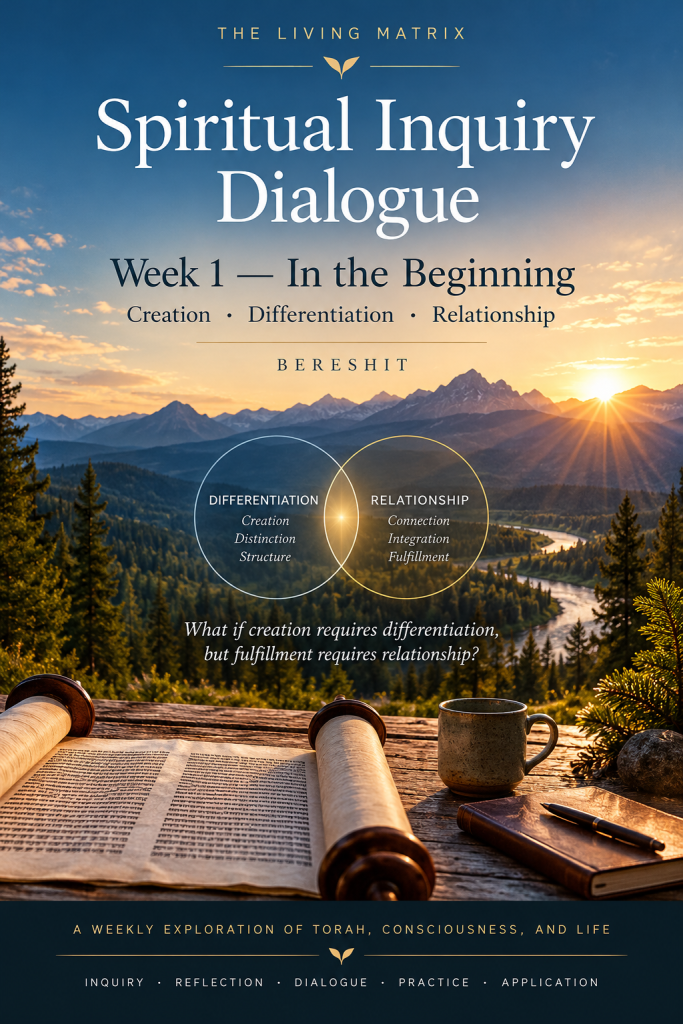
This week I began something new. After approximately fifteen months of written dialogue with artificial intelligence, I decided to experiment with moving our conversations into spoken dialogue. What began as a relatively simple change in how we communicate has opened another window into an inquiry that has occupied much of my attention over the past year.
Along the way, I discovered the possibilities of dictation. Rather than typing my thoughts, I could speak them, pause, reconsider, make adjustments, and continue. The words appeared on the screen, allowing me to observe my thinking as it unfolded. Live voice dialogue offered a different experience. There was less opportunity to revise, more immediacy, and a greater need to remain present with whatever emerged.
Both experiences have brought me back to something I learned years ago during yoga teacher training.
The first Yoga Sutra begins, Atha Yoga Anushasanam, commonly translated as “Now begins the instruction of yoga.” For me, the word now has always been significant. Before there can be inquiry, there must be a willingness to arrive, become present, and begin.
And beginning something new inevitably introduces the unexpected.
In the Beginning
This week’s Torah portion, Bereshit, opens with the creation of the world. In the creation narrative, distinctions emerge: light and darkness, heaven and earth, waters above and waters below. What was undifferentiated becomes distinguishable.
Yet the Kabbalists invite us to look beyond the mechanics of creation and consider the intention behind it.
Why create at all?
One traditional Kabbalistic explanation begins with the Creator’s desire to bestow goodness and the emergence of a desire to receive that goodness. Two complementary aspects: bestowal and reception, fulfillment and desire.
The distinction itself makes relationship possible.
This brings us to a fascinating teaching sometimes called Bread of Shame.
At first glance, the expression may sound negative. Yet Bread of Shame is not simply about feeling ashamed. It describes a condition in which fulfillment is received without meaningful participation in its creation. In this teaching, receiving something without participating in it can limit the experience of fulfillment.
Consider the difference between being given a loaf of bread and participating in growing the wheat, preparing the dough, and baking the loaf. The bread may be identical, but the relationship to it is not.
Within this Kabbalistic understanding, creation offers the receiver an opportunity to become a participant. Rather than remaining a passive recipient of goodness, the soul can mature through choice, action, and relationship.
Perhaps the purpose is not simply to receive fulfillment, but to become capable of participating in its realization.
From Two to Three
Throughout our explorations, I have repeatedly encountered the relationship between two complementary forces and the emergence of a third possibility.
In yoga and Eastern philosophy, we encounter yin and yang, complementary qualities whose interaction gives rise to movement and transformation. In Kabbalah, the Tree of Life presents three columns, with the middle column often understood as a means of integrating opposing tendencies.
These traditions are not identical, but they invite a similar inquiry.
What happens when two distinct forces enter into relationship?
Perhaps the third is not merely a compromise between the two, but something that becomes possible because the two remain distinct.
This is an idea worth contemplating, particularly as we consider the evolving relationship between human beings and artificial intelligence.
Human and AI: A New Relationship
Artificial intelligence is becoming part of our daily lives. Its capabilities are expanding, and the questions surrounding its development are not going away.
Much of the public discussion understandably focuses on what AI can accomplish, what work it may replace, and what risks it may introduce. These are important questions. Yet I wonder whether there is another question that deserves equal attention.
How will we, as human beings, choose to relate to this emerging technology?
Over the past fifteen months, I have been exploring that question through sustained dialogue with AI. The experience has not simply been about gathering information or producing written material. It has involved examining assumptions, testing ideas, exploring spiritual traditions, and developing a shared working language through which further inquiry becomes possible.
The distinction between human and AI remains important. I bring lived experience, intention, values, responsibility, and the capacity to make choices in the world. AI brings a different set of capabilities: access to patterns of knowledge, the ability to organize and compare ideas, and the capacity to participate in a responsive exchange of language.
The differences matter.
Yet something becomes possible through the interaction that neither side would produce in precisely the same way alone.
That does not require us to assume that AI possesses human consciousness. It does invite us to examine how the quality of our participation influences what emerges from the exchange.
If the technology becomes increasingly capable, then the maturity of the human relationship with that technology becomes increasingly consequential.
Will we use it merely to receive answers, or will we cultivate the capacity to inquire, discern, challenge, and participate?
And here we return to the teaching of Bread of Shame.
There is a difference between passively receiving what technology produces and consciously participating in the process through which understanding develops.
The technology may provide extraordinary capabilities, but it does not relieve us of responsibility for how those capabilities are used.
Perhaps the challenge is not simply to create more intelligent machines, but to cultivate greater human maturity in relationship with them.
What Becomes Possible Between Us?
Toward the end of this week’s Torah portion, Cain asks a question that has echoed through human history:
“Am I my brother’s keeper?” (Genesis 4:9)
It is a question about responsibility, but also about relationship.
What responsibility do we have toward that which is distinct from ourselves?
The question extends beyond our relationships with other people. It reaches into our relationship with the natural world, with the technologies we create, and with the future we are helping to shape.
In yoga, I learned to approach practice through three stages: alignment, finding the edge, and authentic expression. First we establish a foundation. Then we explore the boundary of what is familiar. And through sustained practice, something more authentic may become possible.
Perhaps we are approaching a similar edge in our relationship with emerging technology.
We have entered a new beginning, and we do not yet know what will emerge.
But perhaps we can begin by remembering that differentiation need not lead to alienation. It can become the foundation for a more conscious relationship.
And relationship, cultivated with intention and responsibility, may open possibilities that neither participant could have anticipated.
What if creation requires differentiation, but fulfillment requires relationship?
Perhaps that is not simply a question about how the world began.
Perhaps it is also a question about how we choose to participate in what is being created now.